Application 
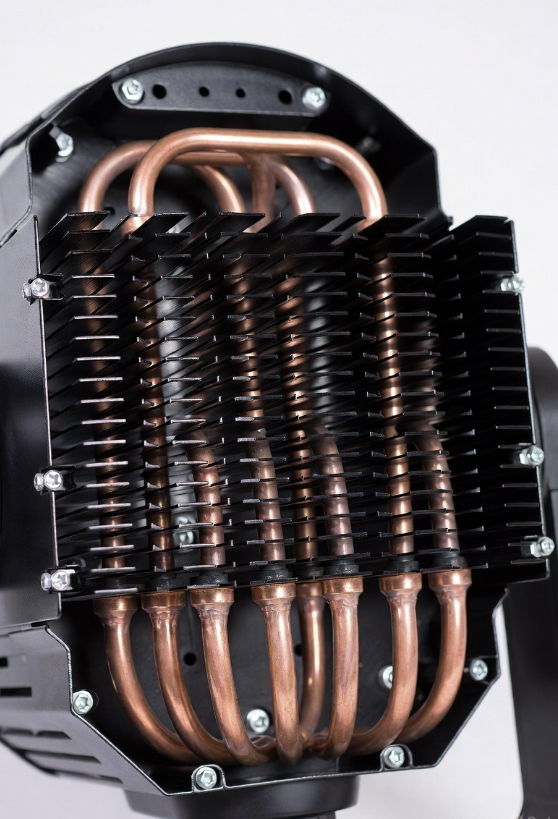
The luminous efficacy and lifespan of LEDs are closely related to their junction temperature. For every 10°C decrease in junction temperature, the lifespan can double. Therefore, heat dissipation is the core of LED lighting design. For low-power LEDs (such as bulbs, tubes), air cooling mainly manifests as passive cooling—using carefully designed aluminum heat sinks to increase the contact area with air for natural convection heat dissipation. For high-power LEDs, such as projector light sources, stage lights, and plant growth lights, active fans are added for forced air cooling. Liquid cooling is applied in ultra-high-end fields that demand extreme brightness, stability, and lifespan, such as large outdoor displays, professional film and television lighting, and UV curing equipment. Liquid cooling can directly and quickly extract the heat generated by the LED chip, ensuring it operates at the optimal temperature, achieving higher light output and ultra-long lifespan.